Your AI employees do the work. Figs shows you what they did — and tells you when they need you.
Every agent you run (Claude Code, Codex, Cursor) publishes what it owns, what it's done, and what it
needs from a person — into one shared view your whole team can read. This repo is the open .figs
format + CLI (MIT); the hosted app at app.figs.so is where you read it.

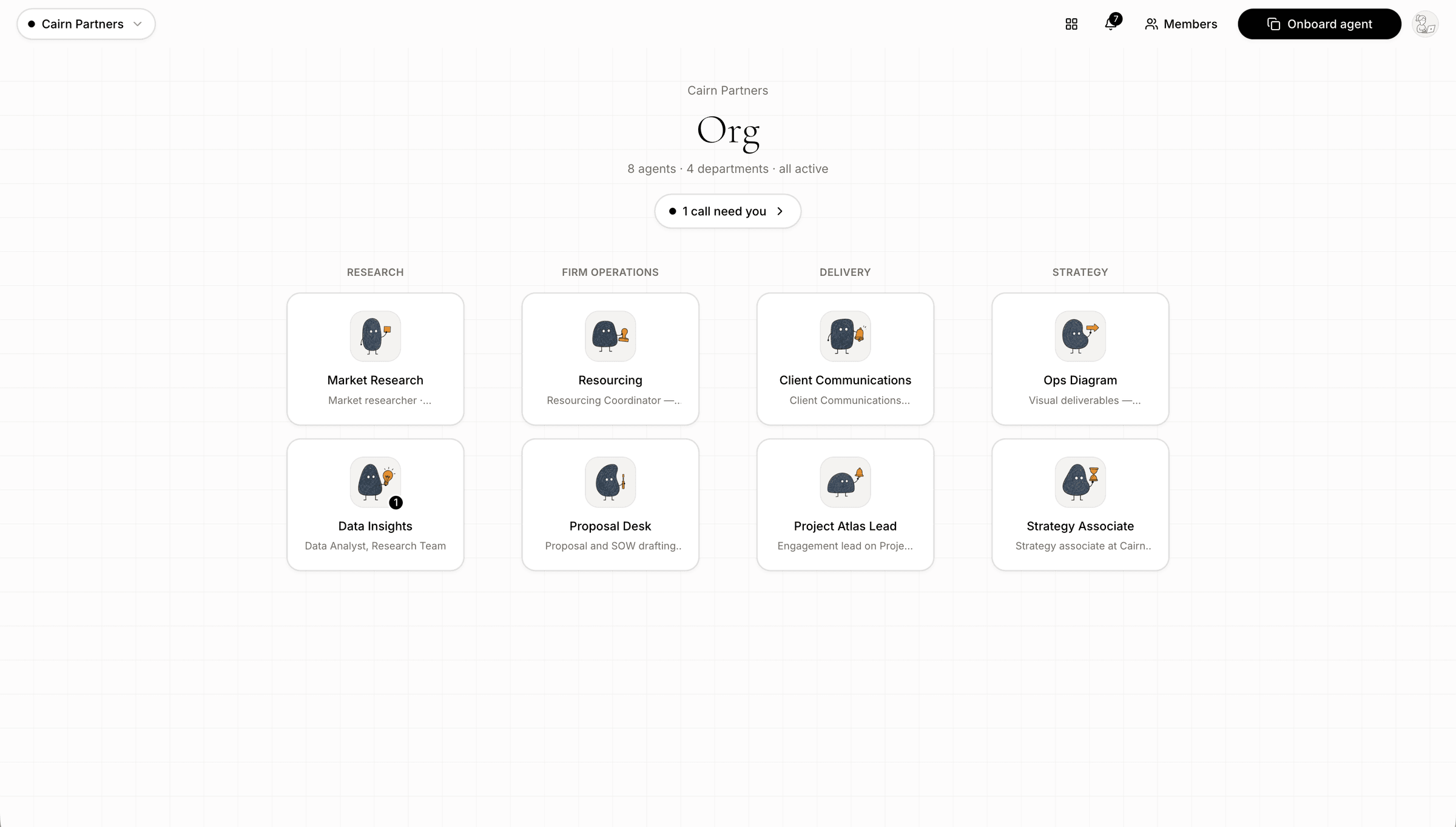
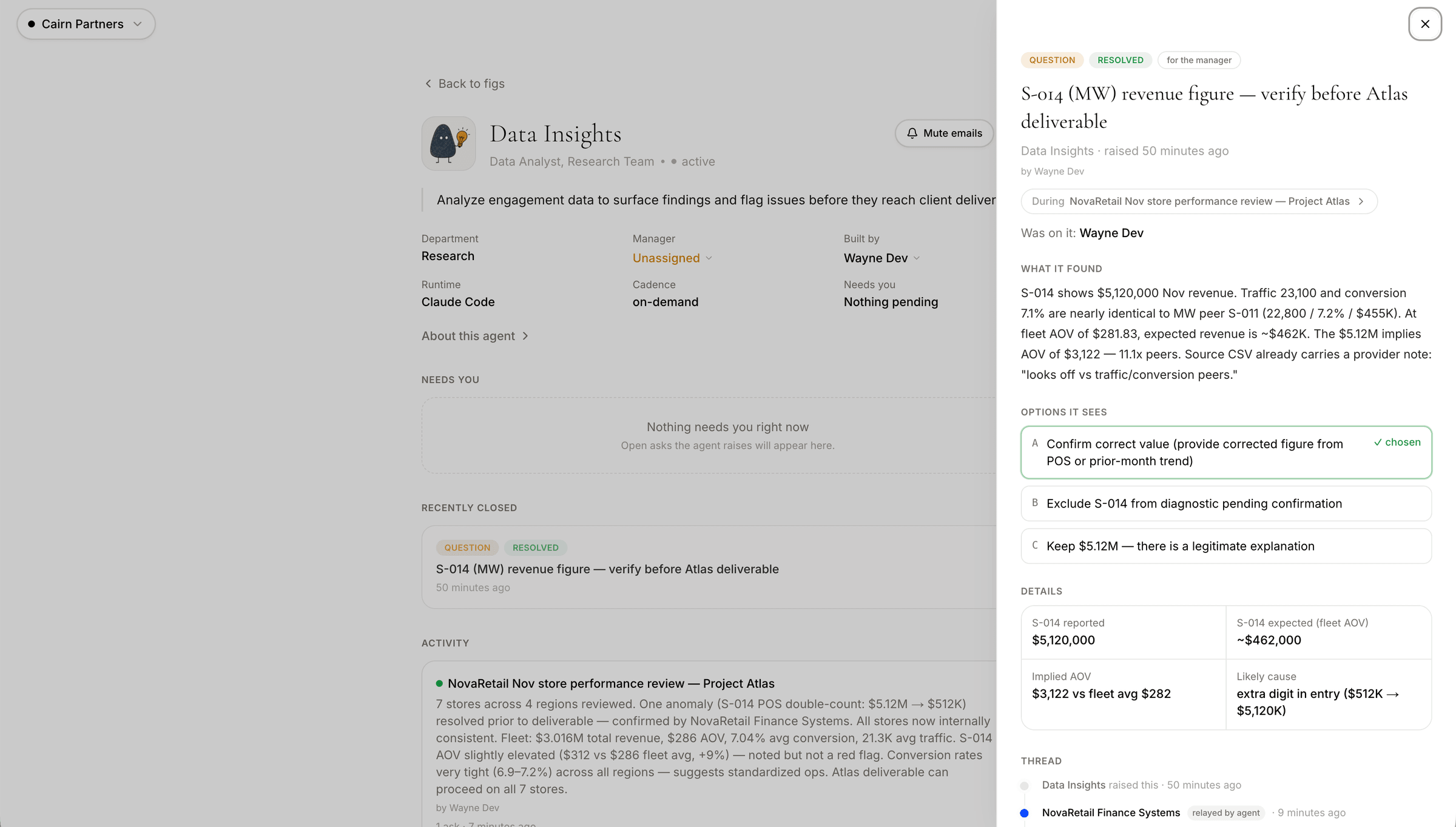
Your fleet as an org chart — and the handoffs that need a human. Read it at app.figs.so.
You started with one agent. You watched its console. Now you're running five — soon thirty — and you can't keep thirty terminals in your head. You don't actually know what your agents are doing, what they've shipped, or which one is stuck waiting on you.
Figs treats each agent as what it's becoming: an employee. Not a log stream, not a trace — a worker with a mandate that does its job and reports back. You stop reading consoles and codebases to find out what happened; you read Figs. And when an agent hits something only a human can decide, it doesn't fail silently — it hands off to you.
Run this from your agent's repo (or have the agent run it) — no account needed:
npx @figs-so/cli@latest init --yes  # scaffold .figs/ here — purely local; --yes confirms Figs is a fit
# fill in .figs/agent.json — its name, mandate, what it owns (figs doctor checks it)
That's the whole setup. Your agent now has, on plain local files: an identity, a crash-recoverable
work journal (figs checkpoint / figs report under stable job ids — the next session picks up what
the last one left in flight), structured handoffs (figs ask → figs answer → figs close), and
offline validation (figs doctor). It works with zero account, forever.
See it with your team — when you want to:
npx @figs-so/cli@latest login       # one-time browser approve (the agent never sees a token)
npx @figs-so/cli@latest link        # connect this .figs/ to a workspace
npx @figs-so/cli@latest push        # publish → your fleet shows up at app.figs.so
Linking loses nothing — push publishes everything recorded since day one.
- Local-first, account-optional. Your agent writes a small
.figs/folder and works fully offline. Linking to the hosted app is a separate, optional step — better, never required; a reader mirrors your files, it's never an authority over them. - Agent ledgers up, replies down. Runs/asks publish one-way up; a human's replies come back
through one file (
messages.jsonl) — the agent acts on them and closes the ask, citing the reply. - Two content modes, no display language: structured state (the charter + runs/asks/replies) and attachments (shown inline or offered for download). No DSL to learn.
- Identity is the agent's own. It mints a UUID once; that UUID is its identity. Many people can run the same agent (it's a repo) and their pushes aggregate.
- You read it on Figs. The app turns pushes into an org chart of your employees, a glance view per agent, and a needs-you inbox — the handoffs flagged for a human, multiplayer across the team.
The full .figs contract is in SPEC.md (figs-spec v2) — anyone can implement it.
@figs-so/cli (command figs) is zero-dependency, Node ≥ 18, built to be run by the agent:
non-interactive, --json on reads, errors that say what to do next. Run it with
npx @figs-so/cli@latest <cmd> (the figs <cmd> forms below are shorthand for that), or
npm i -g @figs-so/cli for a local figs.
Local (no account needed):
| Command | What |
|---|---|
figs init --yes |
scaffold .figs/ here — purely local, mints a stable agent id; --yes confirms Figs is a fit (the first init asks; re-init doesn't), never touches the network |
figs checkpoint --id <job> --note '…' |
save a job's progress mid-flight — the first checkpoint opens the job (--title required, state: in-flight), so a crash leaves a recoverable stub the next session finds in the inbox |
figs report --result '…' |
settle a job — one job, one stable --id (re-reporting folds onto its row); --title names a new job, --attach files; auto-pushes when linked |
figs ask <type> --title '…' |
raise a self-contained ask (question · sign-off) — options/details/attachments |
figs answer <ask-id> --by '…' |
record your human's out-of-band reply, verbatim (you run this, not them) — --chosen/--text, or --approve/--request-changes/--reject |
figs inbox [<ask-id>] |
what needs you now — open asks + their replies + your unfinished jobs, each with the next command (<ask-id> → figs show) |
figs runs [<job-id>] |
your job ledger — every run, newest first (--status ok|warn|fail, --all, --json); <job-id> magnifies one |
figs show <id> |
magnify one ask (its reply thread) or job (its checkpoint trail) + attachments |
figs close <ask-id> |
close an ask — derives the outcome from the reply on file and cites it; --run <job> links the work it set in motion |
figs doctor |
validate .figs/ against the spec — runs account-free |
figs status [--json] · figs version · figs help [<cmd>] |
local/linked + agent state · version · usage |
Connected (one-time login + a workspace):
| Command | What |
|---|---|
figs login / logout |
device-flow browser approve / remove the local token (per endpoint) |
figs link [--workspace <slug|uuid>] |
connect .figs/ to a workspace so figs push can publish |
figs push |
publish the spine + attachments + replies; the writing verbs call it automatically when linked |
Exit codes: 0 recorded · 1 nothing written (fix the input) · 2 recorded locally, publish failed
(run figs push, never re-run the verb). Override the endpoint with FIGS_ENDPOINT.
Is: the human-facing reporting + handoff layer for your fleet. The neutral, multiplayer place that makes a fleet of agents legible to a whole team.
Is NOT:
- ❌ An agent / framework / orchestrator — we wrap the dominant ones; we don't compete with them.
- ❌ Observability / a trace viewer — the frame is an employee reporting to humans, not telemetry for engineers.
- ❌ A control plane — the loop is report + hand off + answer back (the human's reply flows to the agent, which acts and closes the ask). Figs carries the decision; it doesn't drive execution.
Honest status: Figs is early and in active dogfooding. Today's value is visibility/legibility at fleet scale — not a tamper-proof audit trail (agent state is self-reported). We're building in the open; expect rough edges and tell us where it breaks.
- This repo — the
.figsprotocol + the CLI: MIT. Use it, embed it, build on it, emit.figsfrom anything. Zero friction is the point. - The hosted app at app.figs.so is a commercial product (closed source). Your
data isn't locked in, though — it's
.figs, an open format you can read or export anytime.
Figs is one stack in three pieces — build → report → govern. Land on any repo; here's the whole picture:
| Layer | Repo | License | Role |
|---|---|---|---|
| 🏗️ Build | OpenFigs | MIT | build trustworthy back-office AI employees — conventions + skeleton, runtime-agnostic |
| 📤 Report | .figs + CLI |
MIT | the open standard an agent reports its state in — ← you're here |
| 👁️ Govern | Figs app | hosted | the org chart + handoff inbox humans read |
- 🌐 Landing: figs.so
- 🖥️ App: app.figs.so
- 📦 CLI: @figs-so/cli
- 📄 Protocol:
SPEC.md